Python · chapter 11 of 13
Accuracy and validation
"Accurate generator" is a claim that should be backed by numbers. GRNLab is checked at three levels.
1. Unit tests
tests/ holds 50 pytest tests (pytest in the python folder). They cover analytic steady states of one- and two-stage models, finite-difference checks of every Jacobian, the textbook behaviour of the motifs (bistable toggle, oscillating repressilator and Goodwin loop, pulsing incoherent feed-forward loop, monotone coherent one), seeding, every noise model, perturbations, stimuli, steady states, screens, export round trips, and figure rendering.
2. The accuracy audit
python -m grnlab.audit exercises the public API end to end against closed-form results and writes AUDIT.md. It is independent of the unit tests and meant to be rerun after any change to the kinetics or integrators.
| Check | Analytic result | Tolerance |
|---|---|---|
| Unregulated gene trajectory | x(t) = x* + (x0 - x*) e^{-gamma t} | 1e-6 |
| Hill function at threshold | h(K) = 1/2, h'(K) = n / (4K) | 1e-14 |
| Activation-edge steady state | closed form from x1* = vmax/gamma | 1e-8 relative |
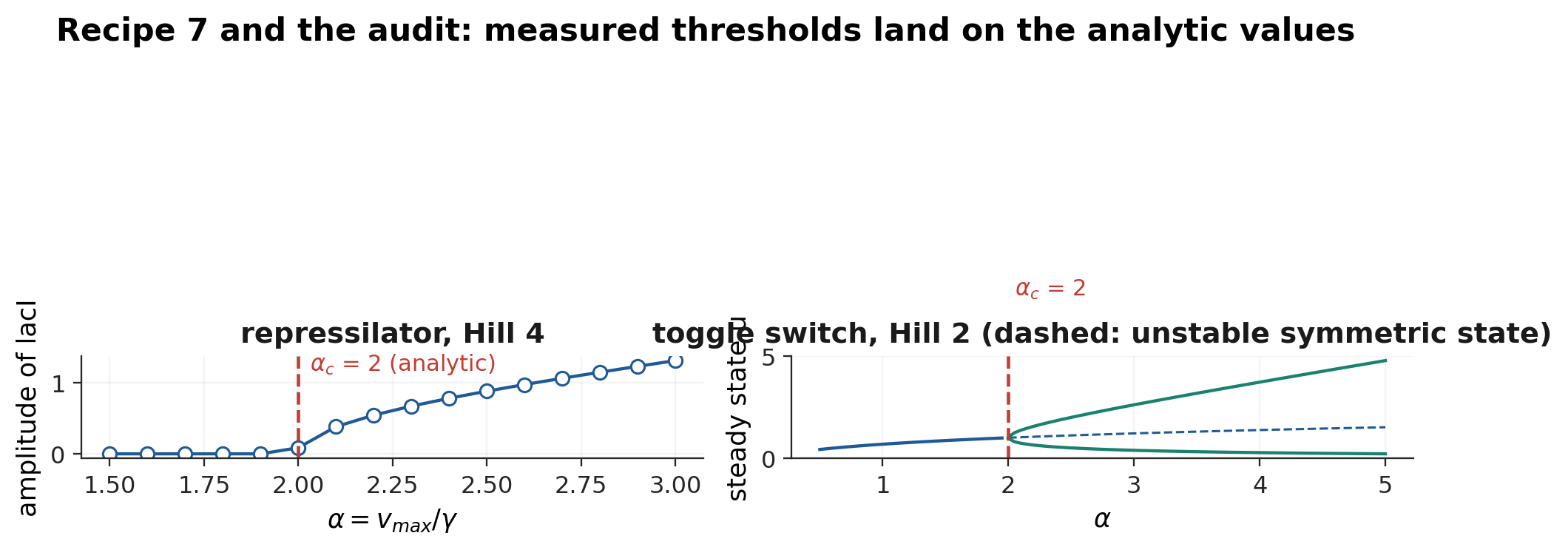
| Repressilator Hopf threshold (Hill 4) | alpha_c = 2 (loop slope n x*^n / (1 + x*^n) = 2 at x* = 1) | 1e-6 |
| Below/above threshold | decays / sustained oscillation | |
| Toggle switch bistability threshold (Hill 2) | alpha_c = 2 | 1e-6 |
| Jacobian vs central differences | 0 | 1e-6 |
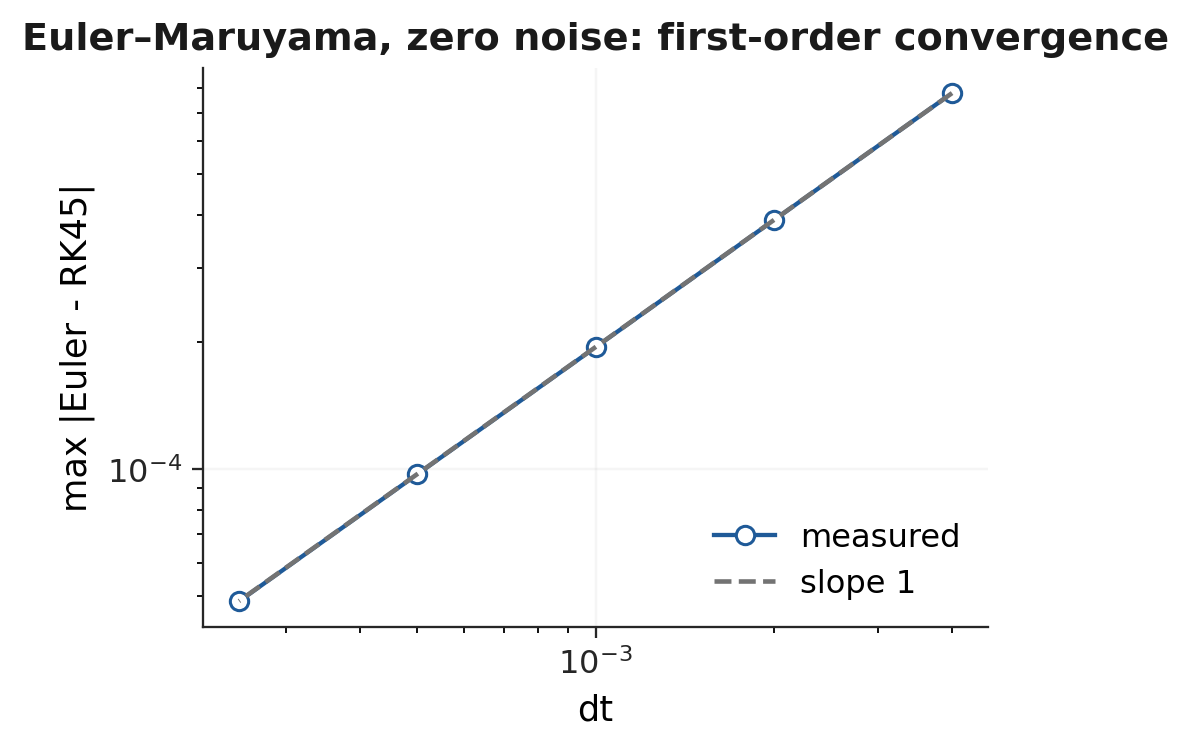
| Euler–Maruyama convergence | error ratio 2 when dt halves | 0.3 |
| Additive noise, linear gene | stationary variance sigma^2 / (2 gamma), mean vmax/gamma | 10 % |
| Chemical Langevin, linear gene | Fano factor sigma^2 (linear-noise approximation) | 8 % |
| Two-stage protein level | q* = beta m* / gammaP | 1e-8 |
| Fast-protein limit | two-stage steady state equals one-stage | 1e-5 |
| Step stimulus | exact exponential after the switch, exactly zero before | 1e-6 |
| Knockout screen | every knockout with a resolvable effect (above 1e-3 log2 units) moves its target in the sign predicted by S | exact |
| Seeds | two runs are bit-identical | exact |
The last run passed 19 of 19 checks; the measured values are in python/AUDIT.md. The MATLAB toolbox runs the same audit and passes it too.
python -m grnlab.auditcheck expected measured error tol pass Unregulated gene x(t): max |ODE - analytic| 0 1.01804e-07 1.02e-07 1e-06 True Hill h(K) = 1/2 0.5 0.5 0 1e-15 True Hill dh/dx at K = n/(4K) 0.441176 0.441176 5.55e-17 1e-14 True Activation edge x2* (additive) 1.70927 1.70927 2.22e-16 1.71e-08 True Repressilator Hopf alpha_c (hill 4) 2 2 4.82e-14 1e-06 True Repressilator amplitude at alpha = 1.8 (below threshold) 0 1.97282e-07 1.97e-07 1e-06 True Repressilator oscillates at alpha = 2.4 (above threshold) 1 1 0 0 True Toggle switch bistability alpha_c (hill 2) 2 2 8.88e-16 1e-06 True Jacobian vs central differences (max abs) 0 2.58534e-10 2.59e-10 1e-06 True Euler error ratio for dt halved (expect 2) 2 2.00065 0.000655 0.3 True OU stationary variance sigma^2/(2 gamma) 0.125 0.128342 0.00334 0.012 True OU stationary mean vmax/gamma 20 19.9801 0.0199 0.02 True Langevin Fano factor var/mean = sigma^2 0.16 0.161622 0.00162 0.012 True Two-stage protein q* = beta m*/gammaP 14.7902 14.7902 1.78e-15 1e-08 True Fast-protein limit: max |two-stage - one-stage| steady state 0 1.77636e-15 1.78e-15 1e-05 True Step stimulus x(t): max |ODE - analytic| 0 2.86285e-08 2.86e-08 1e-06 True KO effect sign agreement with S (fraction) 1 1 0 0 True KO screen convergence (fraction) 1 1 0 0 True Seed reproducibility: max |run A - run B| 0 0 0 0 True 19 of 19 checks passed
3. Numerical methods and their limits
- ODE integration. SciPy's RK45 or BDF with
rtol=1e-7,atol=1e-9; solver output is clipped at zero. The integration restarts at every stimulus edge. Sampling is exact at the requested times (the solver is asked for them), not interpolated afterwards. - Steady states. Integration until the relative residual is below
tol, then Newton polishing to machine precision. Oscillators are reported asconverged=Falsewith a time average. - SDE integration. Euler–Maruyama, strong order 0.5, with clipping at zero. The clipping introduces a bias of order
sigma sqrt(dt)near zero; keepdtsmall (the default issample_dt / 20) and, for the linear-noise checks above, expression well above the noise amplitude. Milstein is not needed for additive noise and gives no order improvement for the Langevin form with its state-dependent diffusion unless the derivative is included, so it is not offered. - Chemical Langevin. Valid when molecule numbers are large enough that fluctuations are Gaussian; it is not a Gillespie simulation and will not reproduce bursting or extinction statistics at very low copy numbers.
- Hill kinetics. The model is a phenomenological transcription model: no explicit binding kinetics, no cooperativity between different regulators beyond the AND/OR combination, no delays other than the mRNA stage.
Known limitations
- Additive observation noise is clipped at zero, which biases low values slightly upward; use
sol.x_cleanwhen that matters. - The force layout of
grn.plot_networkdepends on itsseed; labels can still overlap on dense networks above about 80 genes. - The Euler–Maruyama loop runs in Python; long noisy simulations of large networks are the slowest case.
- The multiplicative-logic Jacobian is
O(n^3); usesolver="ode45"above a few hundred genes.