Python · chapter 6 of 13
Perturbations, steady states, and knockout screens
Genetic perturbations
grn.perturb scales the production of chosen genes: the basal rate, the maximal rate vmax, every incoming weight k[i, :], and the gene's entries in model.ic. Genes may be given as 0-based indices or labels. It returns a modified copy; the original model is untouched.
| Argument | Factor | Effect |
|---|---|---|
knockout | 0 | No production; the gene decays to zero and stays there |
knockdown | knockdown_factor (0.5) | Reduced production |
overexpress | overexpress_factor (2) | Increased production |
ko = grn.perturb(model, knockout=[1, 4])
kd = grn.perturb(model, knockdown="G7", knockdown_factor=0.25)
sol = grn.simulate(model, knockout=3, overexpress="G7")   # same arguments
The perturbation is recorded in model.perturbation["gene"] and ["factor"]. Perturbations accumulate if you call grn.perturb on an already perturbed model; grn.simulate, grn.steady_state, and grn.knockout_screen always start from the model you pass them.
Knockouts act on production, not on the network: the ground truth S is unchanged, which is what a benchmark needs. In two-stage models the transcription of the gene is scaled, so both its mRNA and its protein go to zero.
model = grn.build_model("cascade", seed=1)
wt = grn.simulate(model, initial_condition=np.zeros(4), duration=20)
ko = grn.simulate(model, initial_condition=np.zeros(4), duration=20, knockout="G2")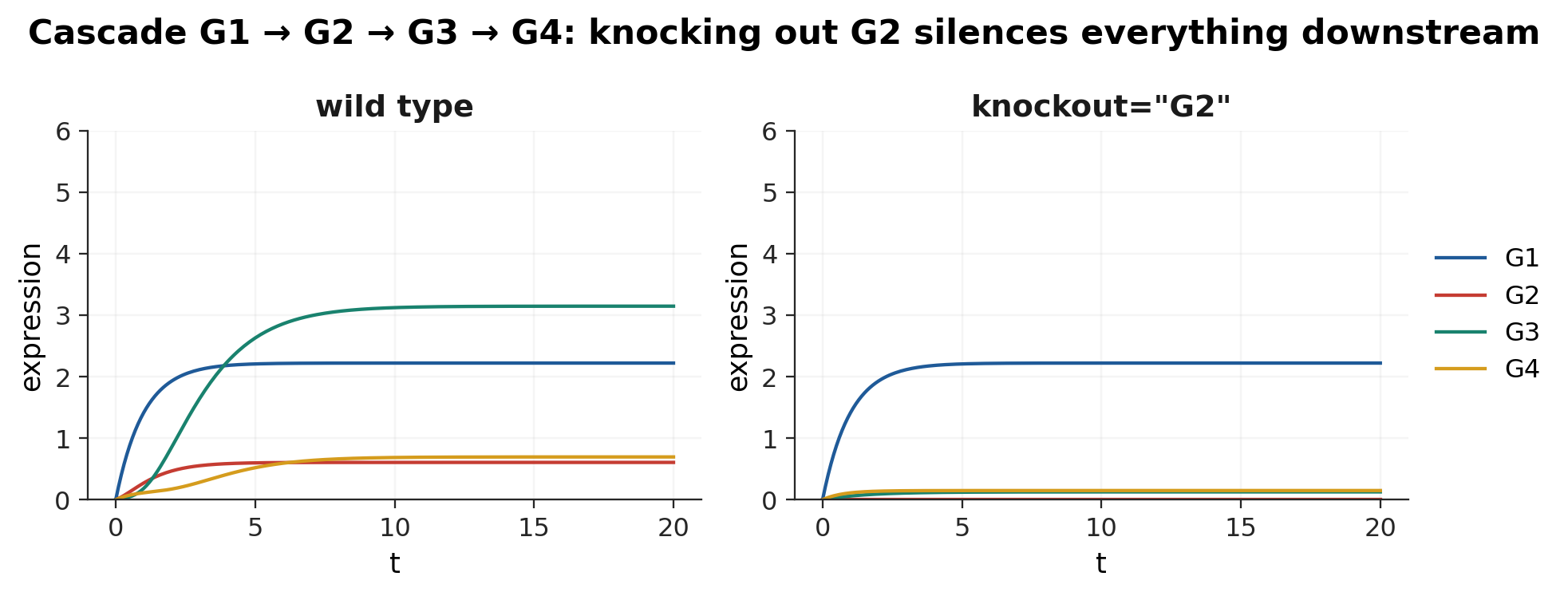
Steady states
xss = grn.steady_state(model, ...) finds a fixed point in two phases: it integrates with BDF (using the analytic Jacobian) in windows of 20 / min(decay) until the relative residual norm(f) / (1 + norm(x)) drops below tol (1e-8) or max_time (2000) is exceeded, then polishes with Newton steps until the residual is at machine precision. xss, info = grn.steady_state(model, ..., info=True) also returns:
| Key | Meaning |
|---|---|
converged | Whether a fixed point was reached |
stable | All Jacobian eigenvalues at xss have negative real part |
residual, time | Final norm(f) and integration time used |
If the model never settles (an oscillator), converged is False and xss is the time average over the last window.
Arguments: initial_condition (the starting point, which selects the attractor of a multistable model), max_time, tol, the perturbation arguments, and stimulus with time (stimuli are frozen at their value at time, default 0).
model = grn.build_model("toggle")
hi, info = grn.steady_state(model, initial_condition=[5, 0], info=True)   # u high
lo = grn.steady_state(model, initial_condition=[0, 5])                    # v high
_, info = grn.steady_state("repressilator", info=True) # info["converged"] is Falsehi = [4.7913 0.2087]
info = {'converged': True, 'residual': 2.220446049250313e-16, 'time': 40.0, 'stable': True, 'time0': 0.0}Knockout screens
screen = grn.knockout_screen(model, ...) produces the steady-state dataset used by the DREAM challenges: the wild type followed by one row per single-gene perturbation.
| Argument | Default | Meaning |
|---|---|---|
type | "knockout" | "knockout", "knockdown", or "overexpress" |
factor | 0, 0.5, or 2 by type | Production scaling |
genes | all | Which genes to perturb, indices or labels |
noise_sigma | 0 | Gaussian measurement noise on screen.X (clean copy in screen.x_clean) |
seed | 0 | Seed for the measurement noise |
stimulus, time | Inputs held at their value at time | |
max_time, tol | As in grn.steady_state |
Each perturbed steady state is computed from the wild-type steady state with the perturbed gene's states scaled by the factor, which keeps the screen on the same attractor branch as the wild type in multistable networks.
| Attribute | Meaning |
|---|---|
X | (len(genes) + 1, dim); row 0 wild type, row i + 1 the perturbation of genes[i] |
rows | Row names: "wildtype" then the gene labels |
converged | Boolean per row |
mrna, protein | The two halves of X for two-stage models |
S, model, labels, state_labels, options | Ground truth and settings |
ko = grn.knockout_screen(model, noise_sigma=0.05)
kd = grn.knockout_screen(model, type="knockdown", genes=["G1", "G4"])
wt = ko.X[0]
lfc = np.log2((ko.X[1:] + 1e-3) / (wt + 1e-3))     # log fold change per knockout
grn.export(ko, "screen.csv")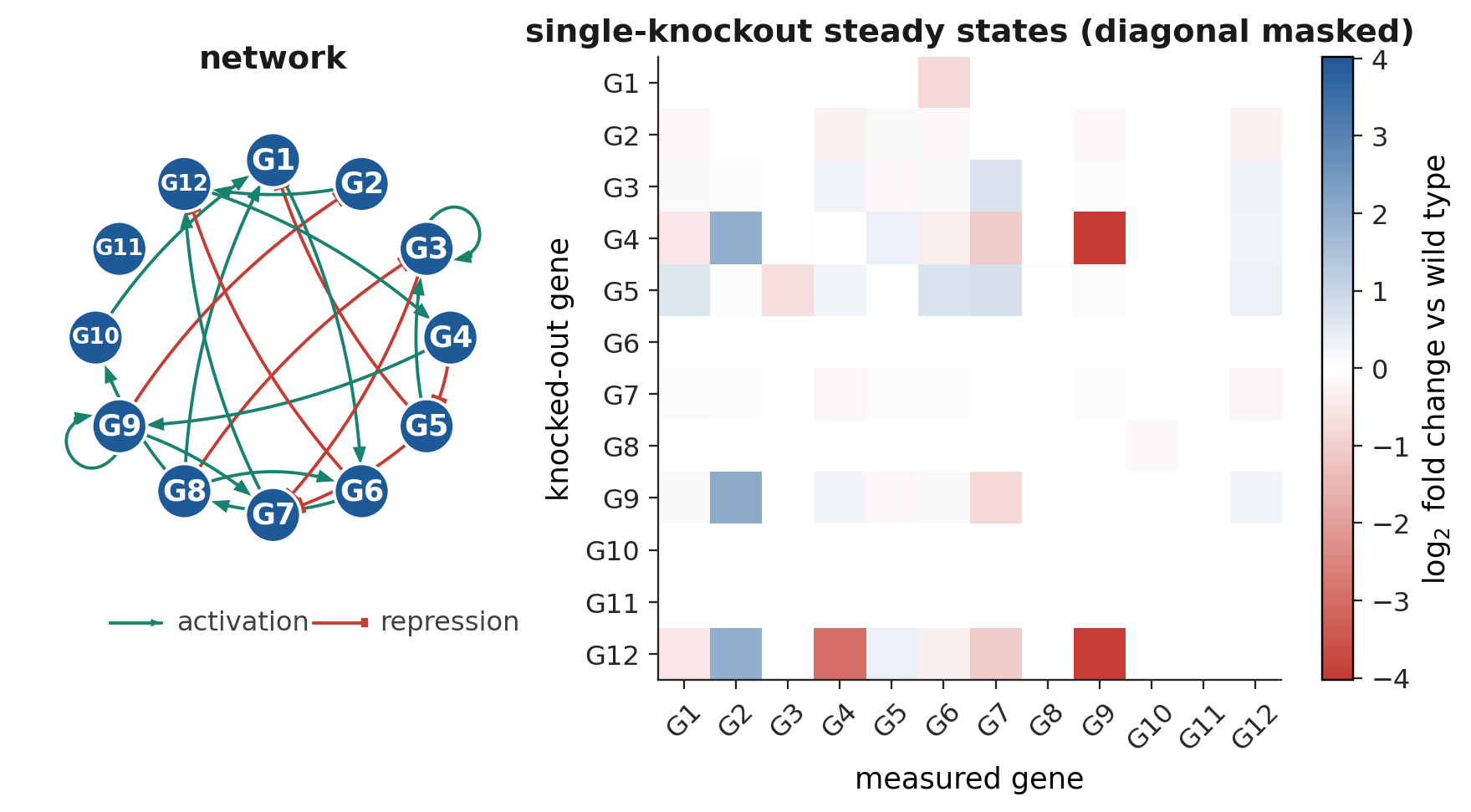
The first rows and columns of the screen:
ko.rows[:5], ko.labels[:6], np.round(ko.X[:5, :6], 3)rows: ('wildtype', 'G1', 'G2', 'G3', 'G4')
columns: ('G1', 'G2', 'G3', 'G4', 'G5', 'G6')
[[1.108 1.216 2.424 3.384 3.329 0.281]
[0. 1.213 2.423 3.407 3.316 0.161]
[0.988 0. 2.458 2.766 3.671 0.256]
[1.25 1.152 0. 4.036 2.943 0.315]
[0.797 4.739 2.504 0. 4.301 0.221]]A useful sanity check on any screen: knocking out an activator lowers its targets and knocking out a repressor raises them. The audit in Accuracy and validation verifies this on a random network.
Double perturbations and dose series
Combine the arguments directly:
sol = grn.simulate(model, knockout=0, knockdown=2)
X = np.array([grn.steady_state(model, knockdown=1, knockdown_factor=f)
              for f in (0, 0.25, 0.5, 0.75, 1)])