MATLAB · chapter 1 of 13
Getting started
GRNLab generates gene-expression data from gene regulatory networks (GRNs) with Hill-function kinetics. Every dataset it produces comes with the ground truth that generated it: the signed regulatory network, every kinetic parameter, the initial conditions, the seed, and the solver settings. GRNLab is a data generator only. It does not infer, recover, or score networks.
Installation
Two options:
- Packaged toolbox. Double-click
releases/GRNLab.mltbx. MATLAB installs it as an add-on, puts it on the path, and registers this guide in the Help browser (Help > Supplemental Software > GRNLab). - From source. Add the
toolboxfolder to the path:
addpath("toolbox")Requirements: MATLAB R2021b or newer. No other toolboxes are needed. Parallel computing is not used.
Ten lines to a dataset
grn.catalog()                                        % what is available

S     = grn.randomNetwork(30, Topology = "scalefree", Seed = 2);   % ground truth
model = grn.buildModel(S, Logic = "multiplicative", Seed = 2);      % kinetics
sol   = grn.simulate(model, Cells = 50, RandomIC = true, ...
            Noise = "langevin", NoiseStrength = 0.2, Seed = 2);     % data

size(sol.x)            % 501 x 30 x 50: samples x genes x cells
sol.S                  % the signed adjacency that generated the data
grn.plotNetwork(model);            % arrowheads = activation, bars = repression
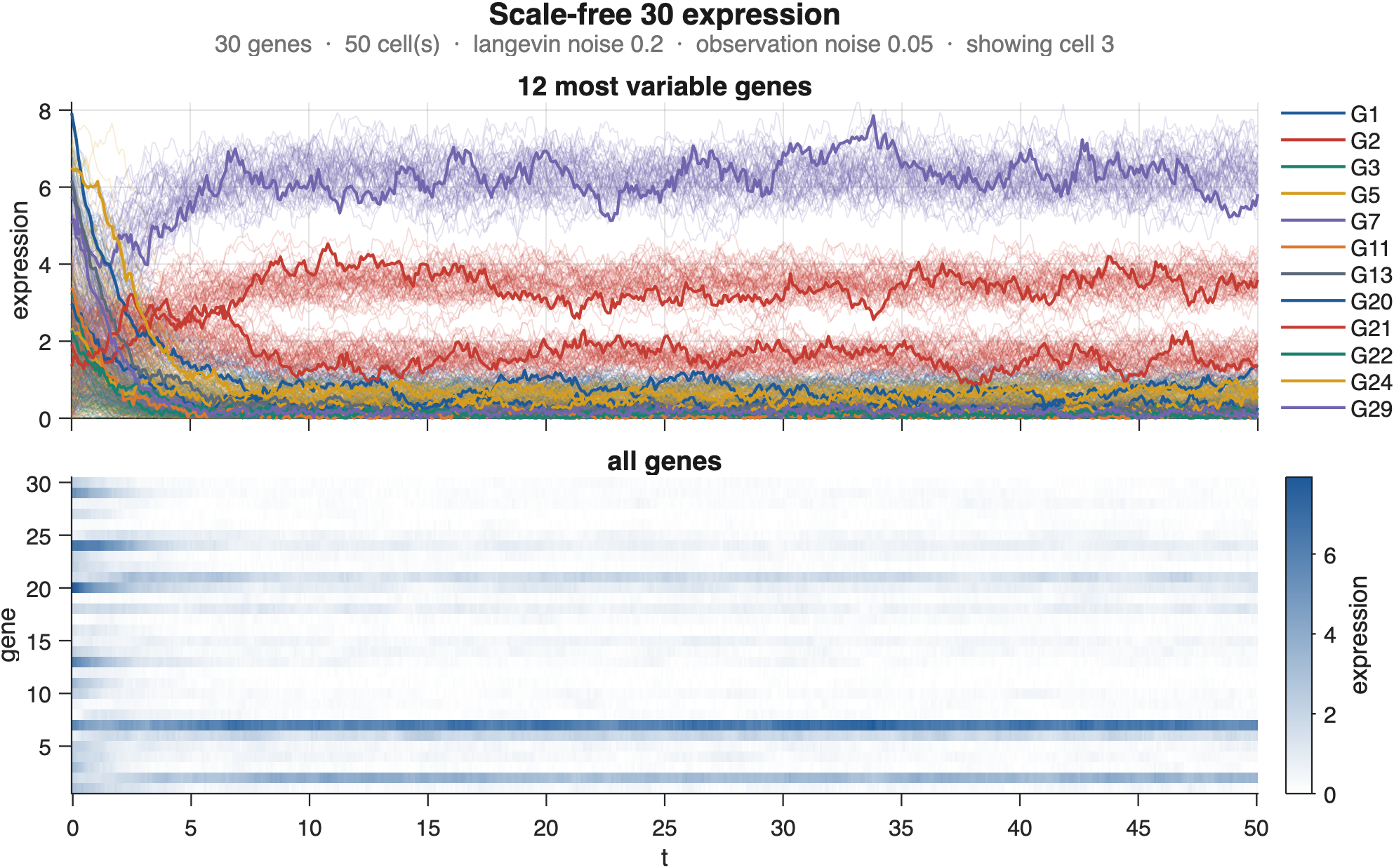
grn.plotExpression(sol, Cell = 3);
grn.export(sol, "grn30.csv"); % + grn30_truth.csv, grn30_adjacency.csvRegulatory motifs (grn.motif / grn.buildModel):
<strong>motif</strong> <strong>genes</strong> <strong>description</strong>
<strong>________________</strong> <strong>_____</strong> <strong>______________________________________________________________________</strong>
"toggle" 2 "Toggle switch: mutual repression, bistable for cooperative binding"
"repressilator" 3 "Repressilator: three-gene ring of repressors, limit-cycle oscillator"
"nar" 1 "Negative autoregulation: fast, robust response"
"par" 1 "Positive autoregulation: slow, possibly bistable"
"ffl_coherent" 3 "Coherent type-1 feed-forward loop: sign-sensitive delay"
"ffl_incoherent" 3 "Incoherent type-1 feed-forward loop: pulse generator"
"cascade" 4 "Linear activation cascade of 4 genes"
"sim" 4 "Single-input module: one TF driving 3 targets"
"bifan" 4 "Bi-fan: two TFs jointly regulating two targets"
"goodwin" 3 "Goodwin oscillator: activation chain closed by repression"
Random topologies (grn.randomNetwork Topology option):
erdosrenyi independent edges, Poisson in-degree
scalefree preferential attachment on regulators (hub TFs)
smallworld directed ring lattice with random rewiring
modular dense modules with sparse inter-module edgesans =
501 30 50
ans =
0 -1 1 0 0 0
-1 0 -1 0 0 0
1 -1 0 0 0 0
1 0 -1 0 0 0
1 1 0 0 0 0
-1 -1 0 0 0 0
ans =
1×6 <a href="matlab:helpPopup('string')" style="font-weight:bold">string</a> array
"G1" "G2" "G3" "G4" "G5" "G6"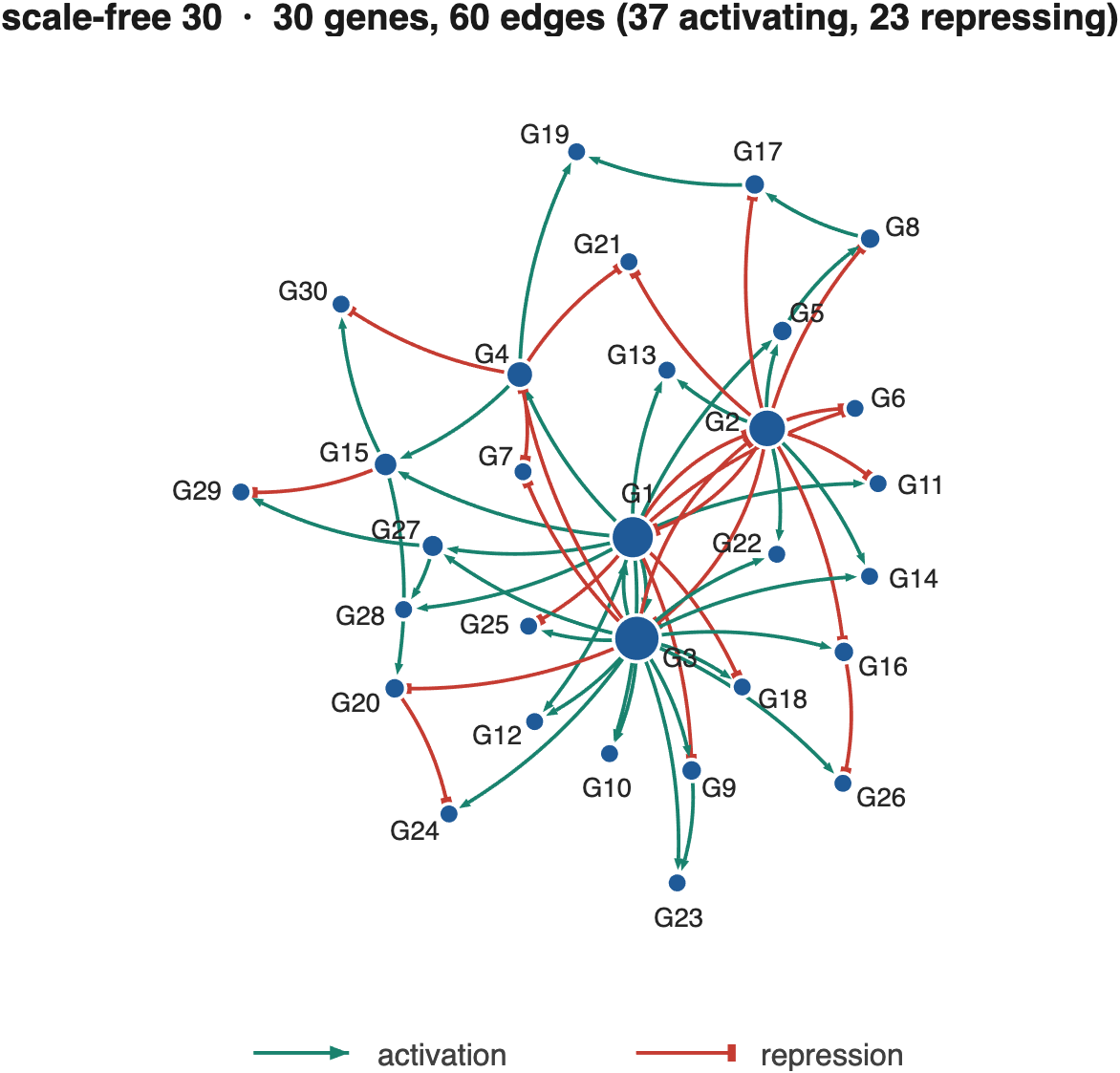
    "/private/var/folders/4p/lyl8zns92f533lvhlldbpm0w0000gq/T/grn30.csv"
    "/private/var/folders/4p/lyl8zns92f533lvhlldbpm0w0000gq/T/grn30_truth.csv"
    "/private/var/folders/4p/lyl8zns92f533lvhlldbpm0w0000gq/T/grn30_adjacency.csv"
The three objects you will handle
| Object | Made by | What it holds |
|---|---|---|
Adjacency S | grn.randomNetwork, grn.motif, or your own matrix | The signed network: S(i,j) = +1 if gene j activates gene i, -1 if it represses it, 0 otherwise |
| Model | grn.buildModel | S plus every kinetic parameter, the initial condition, and function handles for the right-hand side and Jacobian |
| Solution / screen | grn.simulate, grn.knockoutScreen | The data, the time grid, the model that produced it, and the options used |
Everything downstream (perturbations, stimuli, steady states, plots, export) takes a model or a solution and never loses the ground truth.
Motifs by name
Ten classic motifs are registered with parameter presets that reproduce their textbook behaviour. A motif name can be used wherever a model is expected:
sol = grn.simulate("repressilator");             % oscillates
model = grn.buildModel("toggle");                % bistable
hi = grn.steadyState(model, InitialCondition = [5; 0]);
lo = grn.steadyState(model, InitialCondition = [0; 5]);
grn.plotMotifs(); % gallery of all tenhi =
4.7913
0.2087
lo =
0.2087
4.7913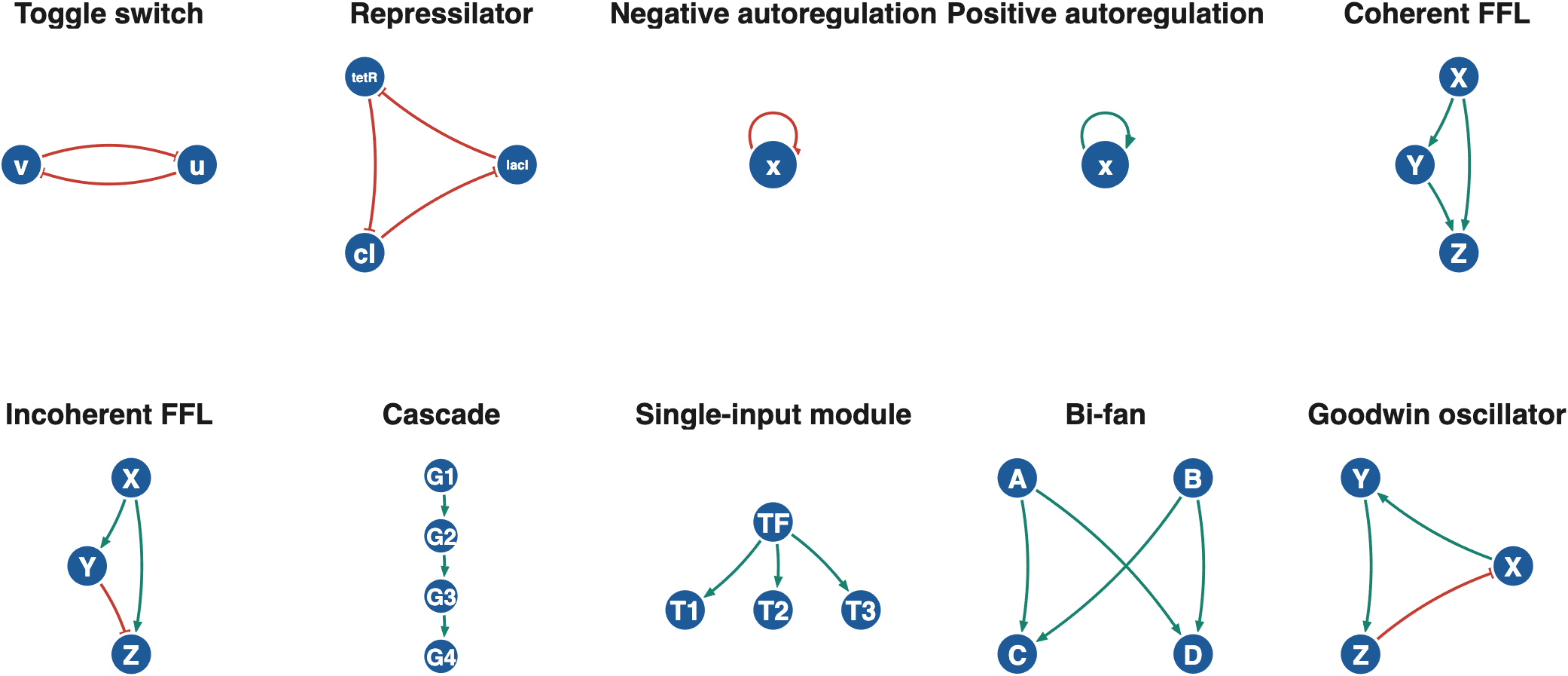
Reproducibility
Every random choice is driven by a Seed option that defaults to 0. Network topology, parameter sampling, random initial conditions, process noise, and observation noise are all seeded, and cell k of a multi-cell simulation uses seed Seed + k - 1. Rerunning the same call gives bit-identical data. The solution struct records the seed and every option, so sol.options and sol.model are a complete recipe.
Where next
- Concepts and conventions: the equations, the orientation of
S, and the fields of a model. - Simulating expression data: solvers, cells, noise, and the solution struct.
- Recipes: complete workflows for benchmark datasets, dose-response experiments, and DREAM-style packages.
- Function reference: every function and option on one page.